U.S. Department of Transportation
Federal Highway Administration
1200 New Jersey Avenue, SE
Washington, DC 20590
202-366-4000
Speaker's Note
Hello and welcome to Inspector Training for Sign Retroreflectivity.
This course is intended for those folks in the field performing maintenance of signs, particularly sign retroreflectivity. New MUTCD rules are in place regarding the maintenance of sign retroreflectivity. This course will walk you through the assessment techniques available for conducting sign maintenance in terms of retroreflectivity.
Speaker's Notes
This is where you discuss the facilities at the location the course is being taught.
Speaker's Notes
Introductions for the course instructors.
Name, affiliation, education, qualifications, and other pertinent info.
Speaker's Notes:
Go around the room with self introductions. Have participants describe their job duties related to sign maintenance so you know the audience better. Take up to 10 minutes or so if needed.
If you have more time, ask participants what they already know about the new minimum retro requirements.
Speaker's Notes:
<Intended audience is maintenance personnel.>
| TOPIC | TIME |
|---|---|
| • Welcome | 15 |
| • Background | 20 |
| • Retroreflectivity | 40 |
| • New retroreflectivity requirements | 15 |
| • Training Slides | |
| • Visual Inspection Methods | |
| – Comparison Panel Procedure | 30 |
| • Calibrated Signs Procedure | 30 |
| • Consistent Parameters Procedure | 30 |
| – Retroreflectivity Measurements | 30 |
| • Resources | 5 |
Speaker's Notes:

Required by MUTCD? NO
Engineering Decision? YES!
Why? To help drivers safely navigate roadways (including older)
Speaker's Notes:

18.9 million drivers age 70+ in 2000
“Older” driver population will continue to grow as baby-boomers age
Speaker's Notes:
Nighttime visibility of traffic control devices is becoming increasingly important as our population ages. By the year 2020, about one-fifth of the U.S. population will be 65 years of age or older. In general, older individuals have declining vision and slower reaction times. Signs that are easier to see and read at night can help older drivers retain their freedom of mobility and remain independent.
I think many of you have heard or seen numbers like these. This is not new news. However, it is important that we maintain our roadways for the road-users and be aware that the road-user demographics are changing. The underlying issue behind today;s training is maintaining the signs for all road-users, including this growing demographic.
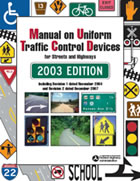
Manual on Uniform Traffic Control Devices
Speaker's Notes:
<Instructor to have some dialogue with class participants using the previous two questions.>
<Official answer is animated with mouse click>
The FHWA has recently made a clarification regarding the type of roads that fall within the jurisdiction of the MUTCD. Here is language from that clarification:
The traffic control devices (TCD) are critical for the safe and efficient transportation of people and goods. The Manual on Uniform Traffic Control Devices (MUTCD), by setting minimum standards and providing guidance, ensures uniformity of traffic control devices across the nation. The use of uniform TCDs (messages, location, size, shapes, and colors) helps reduce crashes and congestion, and improves the efficiency of the surface transportation system. Uniformity also helps reduce the cost of TCDs through standardization. The information contained in the MUTCD is the result of either years of practical experience, research, and or the MUTCD experimentation process. This effort ensures that TCDs are visible, recognizable, understandable, and necessary. The MUTCD is a dynamic document that changes with time to address contemporary safety and operational issues.
NOTE: MUTCD does not apply to: Military bases and other gated properties where access is restricted and private railroad grade crossings are not included in the term “open to public travel.”
Speaker's Notes:
The Manual on Uniform Traffic Control Devices (MUTCD) is incorporated by reference in 23 Code of Federal Regulations (CFR), Part 655, Subpart F and shall be recognized as the national standard for all traffic control devices installed on any street, highway, or bicycle trail open to public travel in accordance with 23 U.S.C. 109(d) and 402(a).
The MUTCD already contains several items on retroreflectivity and having high performing signs.
The responsibility for the design, placement, operation, maintenance, and uniformity of traffic control devices shall rest with the public agency or the official having jurisdiction.
Speaker's Notes:
The Manual on Uniform Traffic Control Devices (MUTCD) is incorporated by reference in 23 Code of Federal Regulations (CFR), Part 655, Subpart F and shall be recognized as the national standard for all traffic control devices installed on any street, highway, or bicycle trail open to public travel in accordance with 23 U.S.C. 109(d) and 402(a).
The MUTCD already contains several items on retroreflectivity and having high performing signs.
MUTCD Section 2A.22 Maintenance
Maintenance activities should consider proper position, cleanliness, legibility, and daytime and nighttime visibility (see Section 2A.09). Damaged or deteriorated signs should be replaced.
To assure adequate maintenance, a schedule for inspecting (both day and night), cleaning, and replacing signs should be established.
Steps should be taken to see that weeds, trees, shrubbery, and construction, maintenance, and utility materials and equipment do not obscure the face of any sign.
Speaker's Notes:
Ask participants if they are meeting the MUTCD criteria in this section?
Get specific … do they do a nighttime inspection? What do they look for? How often? Do they look at sign retroreflectivity? How do they deem if it is adequate? Do they have an established procedure? Have them describe it? You will be able to use the info gained in this series of questions later in the presentation when discussing visual nighttime inspection methods.
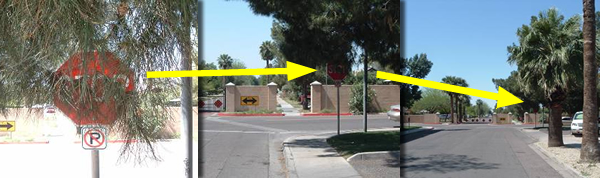
Reasonably safe for day or night travel?
MUTCD Principles:
Speaker's Notes:
According to the MUTCD, the purpose of traffic control devices, as well as the principles for their use, is to promote highway safety and efficiency by providing for the orderly movement of all road users on streets and highways throughout the Nation. Traffic control devices notify road users of regulations and provide warning and guidance needed for the reasonably safe, uniform, and efficient operation of all elements of the traffic stream.
Discuss MUTCD principles. How do they relate to the series of pictures? How do they relate to maintenance of traffic signs … and particularly, how do they relate to min retro levels?
Add notes but then ask what else is wrong with this picture?