U.S. Department of Transportation
Federal Highway Administration
1200 New Jersey Avenue, SE
Washington, DC 20590
202-366-4000

| < Previous | Table of Content | Next > |
| Project: widening and resurfacing a two-lane rural highway | |||
|---|---|---|---|
| Planned Improvements: |
|
||
| Project Environment: | urban | suburban | x rural |
| Project Design Stage: | conceptual (0 to 30%) | preliminary (40 to 80%) | x advanced (over 80%) |
| Project Cost: | < $100,000 | $100,000 - $1,000,000 | x >$1,000,000 |
| Project Owner: | Oklahama Department of Transportation | ||
| Road Safety Audit | |||
| Date of RSA: | 1-3 February 2005 | ||
| RSA Stage(s): | x design stage | RSA of existing roads | |
| RSA team: | staff from Federal Highway Administration Oklahoma Field Office, Oklahoma DOT, and Opus Hamilton | ||
PROJECT BACKGROUND:
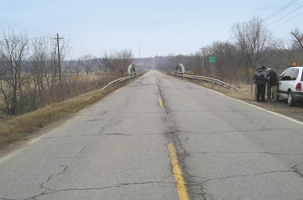
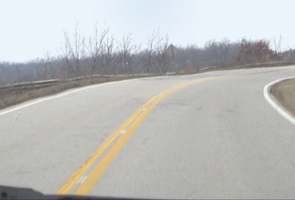
US 60 is a US numbered highway (part of the National Highway System) extending for 350 miles across northern Oklahoma. The RSA team reviewed detailed (90 percent) design stage drawings of upgrades to a 2.9-mile stretch of US 60 in Osage County. Along the upgraded section, US 60 has a posted speed limit of 65 mph, and a reported AADT of 3,500 vehicles. The existing roadway, shown in FIGURE A.3, is a two-lane rural roadway having 12-foot driving lanes with narrow or absent paved shoulders. In addition to resurfacing, the upgrades included:
The RSA team also reviewed proposed construction-stage detours.
 |
 |
| Buck Creek bridge (planned improvements include repaving, bridge improvements, and 8’ paved shoulders) |
adjacent “incidental” section (planned improvements include repaving and 2’ paved shoulders) |
FIGURE A.3 VIEWS OF RSA SITE (OKLAHOMA DOT RSA)
KEY RSA FINDINGS AND SUGGESTIONS:
The key findings and suggestions of the RSA are summarized in TABLE A.2. The DOT responded that changes would be made as suggested except for changes that would involve re-negotiation with property owners or utility relocation (Issue 1), since these processes were already complete, or changes that would entail substantial delay or additional expense (redesign of cross-section elements on the incidental section, Issue 2D). The DOT also declined the suggestion to install rumble strips, since they are not typically used on Oklahoma highways.
KEY LESSONS LEARNED:
It is important to identify the safety benefits of the design as part of the RSA process. The improvements to US60 were motivated largely by safety, to provide a consistent and high-quality roadway where the existing roadway was characterized by poor pavement and roadside conditions. As part of the RSA process, the RSA team identified how the elements of the Design Team’s proposed improvements were expected to positively address existing safety concerns. Examples cited in the RSA report included the following:
Acknowledging the safety benefits of the original design put the RSA findings in an appropriate context.
See also the discussion of “Key Factors for Success” and “Lessons Learned” in the main text.
| SELECTED SAFETY ISSUE (Number and Description) |
RISK RATING | SUGGESTIONS | |
|---|---|---|---|
| 1 | Vertical crest curves limit drivers’ advance view of the intersection of US60 with Bowring Road. | C |
|
| 2 | The safety impacts of improving the incidental section should be reviewed: | ||
| 2A | The overlay may reduce the effectiveness of an existing guardrail. | C |
|
| 2B | The shoulder width will drop from 8 feet to 2 feet for westbound traffic. |
|
|
| 2C | Westbound drivers may fail to follow the horizontal curve near the east end of the incidental section. |
|
|
| 2D | The improved overlay surface may encourage higher prevailing speeds along the incidental section, which may be designed to an outdated standard. |
| |
| 3 | Potential roadside safety issues may be present during construction. | C |
|
| 4 | A proposed guardrail ends at a private driveway. | B |
|
| < Previous | Table of Content | Next > |