U.S. Department of Transportation
Federal Highway Administration
1200 New Jersey Avenue, SE
Washington, DC 20590
202-366-4000

Best for printing: rsa_summer2010.pdf (276 KB)
To view PDF files, you can use the Acrobat® Reader®.
By Becky Crowe, RSA Program Manager
FHWA Office of Safety
Day after day, I’m amazed at all the State and local agencies moving forward with Road Safety Audits. I’d like to take this opportunity and give credit where credit is due. Craig Allred with the FHWA Resource Center has been our primary RSA trainer for the past 3 years and he has been a dedicated advocate of RSAs as a proven safety countermeasure. He travels over 42+ weeks of the year to every corner of our country and the world. From Rhode Island to Idaho to Barbados to Qatar, Craig has been spreading the news about RSAs. He has been instrumental in educating agencies on the eight step process and he’s been the shepherd to thousands, nearly 1,360 students. Thank you to Craig Allred for being such a great instructor and making all our highways safer!!

Rhode Island’s Strategically Targeted Affordable Roadway Solutions (RI*STARS) Program is a new initiative and partnership between transportation planners, traffic engineers, safety engineers and operations staff. It borrows from a Federal program in the 1970s called TOPICS (Targeted Operational Projects to Improve Capacity and Safety) and the Virginia Department of Transportation’s (VDOT) program similarly named STARS. Through RI*STARS, the Rhode Island DOT (RIDOT) will identify critical safety and congestion locations and then work with local partners to develop a detailed improvement plan for selected sites.
RI*STARS focuses on the rapid delivery of low-cost, high-benefit safety and mobility improvements on freeway, secondary and local road systems. The improvements must be low-cost (from a few thousand dollars to $2,000,000 maximum for a project), address existing mobility and safety problem areas, require minimal preliminary engineering and right-of-way, and be quick to implement.
The RI*STARS Program is the result of the FHWA Rhode Island Division and RIDOT participating in RSA training and a Localized Bottleneck Reduction (LBR) workshop.
In addition to providing RSA training, FHWA also sponsored a Localized Bottleneck Reduction workshop in August 2008 where VDOT presented information about their STARS program. In July 2009, RIDOT and VDOT participated in a Peer Exchange which served as a follow-up to the previous year’s workshop. Having the knowledge and understanding of how RSAs can be used to improve safety combined with the benefit of reducing localized bottlenecks, RIDOT chose to establish RI*STARS.
RIDOT will be piloting the RI*STARS Program in Newport, Middletown, and Portsmouth (Aquidneck Island) in conjunction with a corridor study that is being completed by the Aquidneck Island Planning Commission (AIPC). The pilot will consist of approximately 15 spot locations with the greatest need for safety improvements and congestion reduction. An RSA will be conducted at each site this summer and fall, followed by the identification and implementation of countermeasures.
 RSA Presentation: Using 3-D models to evaluate safety during a project’s design phase.
Becky Crowe gave an RSA presentation at the Southern District ITE Annual Meeting in Portsmouth, VA on April 12. The presentation highlighted the benefits of implementing RSAs during the design phase and summarized the RSA design visualization project.
NACO and NADO Webinars
The National Association of Counties (NACO) hosted a webinar on RSAs as part of their Rural Road Safety Webinar Series. The webinar, conducted on March 25, 2010, examined RSAs and the legal issues surrounding the development of an RSA.
The National Association of Development Organizations (NADO) Research Foundation hosted an RSA webinar on June 9. The webinar provided an overview of RSAs by Rosemarie Anderson, FHWA Transportation Specialist, as well as two case study presentations by Keith Nichols, Senior Transportation Engineer for the Hampton Roads Planning District Commission in Virginia, and Chuck Wise, Senior Transportation Planner for the Two Rivers-Ottauquechee Regional Commission in Vermont.
FHWA Field Engineers Conference
Craig Allred gave an RSA presentation during the FHWA Field Engineers Conference in Dallas the week of April 19. The presentation provided details about the RSA process and highlighted benefits of using RSAs.
RSA Panel at Lifesavers Conference
The 2010 Lifesavers Conference in Philadelphia, had nearly 1,800 attendees participating in a range of workshops and panels. The program agenda included a panel moderated by Rebecca Crowe, FHWA RSA Program Manger. Priscilla Tobias, Illinois DOT State Safety Engineer, Trooper Bridget Rice of the Illinois State Police, and Fred Lees, Montgomery County, Maryland also presented on RSAs. Next year’s conference will be in Phoenix, Arizona. March 27-29, 2011. http://www.lifesaversconference.org/
RSA Booth at NARC Conference
The RSA booth was on display at the National Association of Regional Councils (NARC) 44th Annual Conference and Exhibition in Cleveland June 15 – 17. In addition, RSAs were included as part of the session on developing regional safety programs.
Other RSA News
In response to local elected officials and the public, Paul Mattox, Secretary of the West Virginia Department of Transportation (WVDOT) reached out to the FHWA Division office for potential solutions to address safety concerns on WV 62 in Putnam County. The FHWA Division office suggested conducting a Road Safety Audit (RSA). The WVDOT assembled a multi-discipline team with members from FHWA, WVDOT, and the West Virginia State Police.
The RSA on WV 62 was conducted February 23-25, 2010, and the findings were reported in a closeout session with the WVDOT Secretary and his staff on February 26. Following the pilot RSA in Putnam County, Craig Allred, a Transportation Specialist with the FHWA Resource Center, conducted RSA training in Charleston on April 27-28. Approximately 35 people attended with participants representing the West Virginia Division of Highways (WVDOH), the West Virginia State Police, the Charleston, WV MPO, and FHWA. Further building on West Virginia’s RSA activity, Craig Allred, Jeff Blanton of the FHWA WV Division, and Donna Hardy from the WVDOH Traffic Engineering Division gave a presentation to approximately 150 people at the 2010 WVDOH Maintenance Conference. Their presentation focused on the RSA concept, findings from the pilot RSA on WV 62, and the future direction of the RSA program in West Virginia.
The WVDOT Secretary is excited about the potential of RSAs in West Virginia. To date, the WVDOH has conducted or scheduled five more RSAs around the state and has plans to conduct at least one RSA per district during the remainder of 2010. In addition, the WVDOH is implementing an RSA policy in fiscal year 2011 that will require RSAs to be conducted at the top five crash locations in each of the ten districts. By conducting their first RSA, not only has West Virginia begun to employ RSAs as a new tool toward highway safety, they have also opened new lines of communication between offices regarding potential barriers to conducting RSAs and implementing findings in West Virginia.
On January 27, 2010, the South Carolina DOT (SCDOT) conducted an RSA on South Carolina Highway 6 (SC-6). SC-6 is a rural farm-to-market road extending through several counties. The RSA team examined a 15 mile stretch of the road in Lexington County.
The population surrounding SC-6 in Lexington County has increased substantially in the last fifteen years and this section of road has been the subject of numerous major projects, particularly in the last year. Currently, a paving and widening project is underway on a one-mile stretch of the highway and is expected to be completed this year.
Most of the road is an asphalt paved two-lane roadway with little or no shoulder, fading edge lines and 12-foot lanes. Speed limits vary from 35-55 MPH. Over the period from January 1, 2004-December 31, 2008 there were 857 crashes reported on this stretch of road, including multiple fatalities.
The RSA Team consisted of engineers, an FHWA representative, and the SCDOT RSA Coordinator. The team identified a number of safety concerns including:
From the RSA, the team was able to identify a number of recommended improvements, some of which are low-cost and quick to install:
Since the RSA was conducted in January, advance intersection and road name signage with retroreflective strips on the posts have been installed at several intersections. SCDOT continues to monitor crash rates on this section of roadway in an effort to determine the effectiveness of newly installed countermeasures.
 safetyP2P@dot.gov
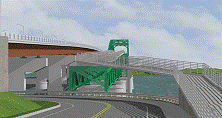 The RSA process can be used during any phase of a project, but one of the most proactive approaches is to focus on pre-construction during the detailed design stage. Typically, an RSA team will review plans and specifications (which provide 2-dimensional drawings) when conducting an RSA during the design stage. For RSA team members that have not been trained in interpreting or do not utilize construction plans on a regular basis, it may be difficult to fully understand the overall design depicted in a set of plans and envision safety concerns. This is where a 3-dimensional (3D) model of the project may be beneficial. Several transportation agencies utilize computer-aided drafting and design (CADD) software to create a multidimensional model of a highway project. These can range from a simple 3D surface model to an interactive 4D model with rendered dynamic objects such as traffic control devices, vehicles and pedestrians. This new capability has assisted transportation agencies across the nation in planning and designing highway projects.
FHWA is currently piloting the use of Design Visualization and 3D renderings of pre-construction projects for RSA teams to perform safety examinations. Locations in Montana and Rhode Island will serve as the initial two pilot sites. The ultimate goal is to develop a 3D rendering of each pre-construction project with planned improvements and have a team perform a Road Safety Audit of a segment of the road or intersection. Changes will then be made to the 3D model based on input from the team and road owner.
If your agency has a project in the design phase and you are interested in participating as a pilot site, please contact Rebecca Crowe, FHWA RSA Program Manager, at rebecca.crowe@dot.gov.
NJDOT’s Safety Impact Teams (SITs) were implemented as a result of a statewide initiative called “Safety First.” Signed into law in July 2003, Safety First established the DOT’s Safe Corridor Program. A Safe Corridor (SC) is defined as a portion of state highway that has experienced a higher than average number of crashes as compared to similar type roadways. New Jersey currently has 140 miles of designated SCs. It is important to identify corridors; however, reducing crashes is NJDOT’s main goal of the SITs (Safety Impact Teams).
 The NJDOT, in conjunction with the FHWA Division Office, developed the SIT process; a 3-day event that evaluates and recommends potential solutions to a Safe Corridor crash challenge. This process brings together a multi-disciplinary team of safety partners to provide a broad perspective of potential solutions. Besides DOT members from traffic engineering, safety, pedestrian and bicycle, and maintenance operations, external stakeholders such as State and local law enforcement, FHWA, Governor’s Representative from Highway Safety, Metropolitan Planning Organizations, local businesses, local citizens, elected officials, NHTSA, transit, media, AAA, AARP, and university members have been active participants.
The first day of the SIT evaluation is an overview of the corridor (10 miles) and relevant data such as crash summaries, pavement condition rating, signal timings, roadway geometry, on-going or future construction and/or maintenance activity, and future development of the area. The second day of the SIT is a field review of the corridor. Members are asked to provide observations and recommendations about travel and operational activities at those locations. All thoughts and potential solutions are recorded for further consideration. Day 3 of the SIT gives the team members the opportunity to review the recommended improvements recorded on the second day. The recommendations are further refined during this time to determine feasibility, time frame (short, medium, long term), responsible party, and a general cost estimate (low, medium, high). A full report of SIT activities and a matrix of recommendations are then sent to each team member within 45 days, with implementation of the solutions by each respective agency. Results vary for each individual corridor, but in general, recent results from the implementation of short term solutions has shown a reduction of crashes of 9%, a 22% reduction in injuries, and a 30% reduction in fatalities.
In an effort to facilitate incorporating solutions beyond engineering, the NJDOT added a Safe Corridor Coordinator (SCC). The SCC is a member of the New Jersey State Police (NJSP) who acts as a liaison between the DOT and the municipalities with a Safe Corridor. The SCC regularly visits the corridors and local law enforcement officials to discuss enforcement activities in the corridors and share best practices and lessons learned. In addition, the NJDOT expanded usage of its Highway Safety Fund monies to include educational safety campaigns and programs within the corridor, in an effort to implement educational solutions from the SITs.
Based on the results, the NJDOT is confident the Safe Corridor Program and the Safety Impact Team process has been successful in fulfilling the mission of reducing crashes and saving lives on New Jersey’s roadways. The NJDOT looks forward to continued utilization of this process.
For additional information, contact Heather Rigdon, Heather.Rigdon.ctr@dot.gov
|
|
|
 Join us in Newport, Rhode Island this September for the “Mission: Safety 2010 Conference – Engineering Behavior” hosted by the Rhode Island DOT in conjunction with FHWA and NHTSA. This innovative conference will bring together engineering and behavior modification specialists from across the nation to discuss the common goal of reducing fatalities and injuries on our highways. RSA sessions and training will be included as part of the program agenda. The event will take place at the Newport Marriott Hotel. For complete conference information, including how to register, please visit www.dot.ri.gov/safety2010.